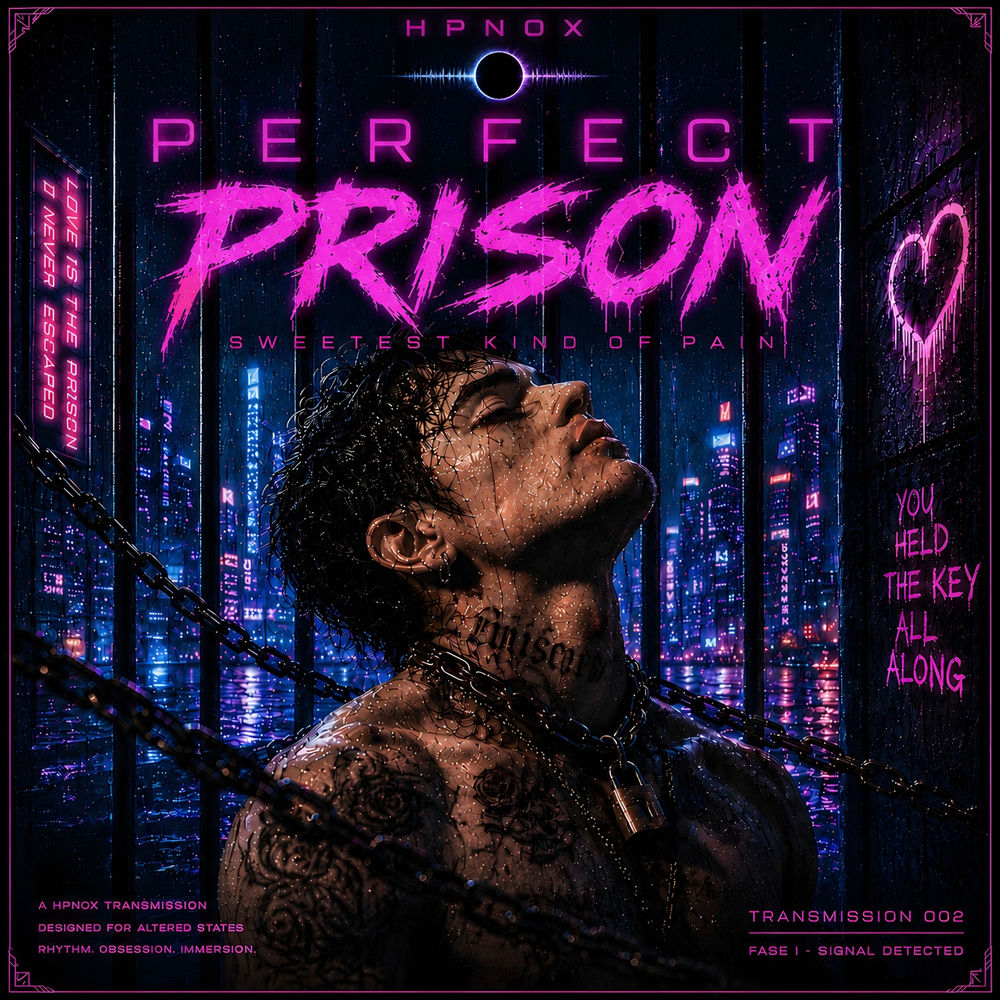
Perfect Prison
HPNOX
Elegí dónde escuchar
- Spotify Reproducir →
- Apple Music Reproducir →
- YouTube Music Reproducir →
- Deezer Reproducir →
- Tidal Reproducir →
Significado.
Perfect Prison nace de una contradicción peligrosa: querer escapar de alguien y, al mismo tiempo, seguir sintiendo que ese lugar era el único donde uno pertenecía.
La canción habla de un amor que no encierra con barrotes visibles. No hay paredes, no hay cadenas reales, no hay una puerta cerrada. Y justamente por eso es más difícil salir. Porque la prisión no está afuera: está en la memoria, en el cuerpo, en la forma en que una persona puede quedarse respirando dentro de uno incluso después de haberse ido.
En Perfect Prison, el amor aparece como una experiencia intensa, casi adictiva. Una mezcla de deseo, pérdida y dependencia emocional. La persona que canta sabe que esa relación lo destruyó, sabe que lo alejó de quien era, sabe que confundió el cielo con una condena. Pero también reconoce algo más incómodo: si esa persona volviera a llamar, probablemente volvería a caer.
Ahí está el centro emocional de la canción.
No es una historia sobre alguien que no entiende el daño. Es peor. Es la historia de alguien que sí lo entiende, pero todavía no logra dejar de amar la forma en que ese daño se siente.
La frase "The most dangerous prison is the one that feels like home" resume el corazón de la canción. Hay amores que duelen, pero duelen con una familiaridad tan profunda que terminan pareciendo refugio. Uno sabe que debe irse, pero algo en el cuerpo insiste en volver. Como si el dolor también tuviera memoria. Como si algunas heridas aprendieran a sonar como hogar.
La imagen de la llave atraviesa toda la canción. Él buscaba libertad, pero la otra persona siempre tuvo el control. Sus labios tenían la llave. Sus besos eran cadenas. Cada "I love you" se sentía como unas esposas emocionales. Y aun así, dentro de esa cárcel perfecta, había placer, deseo, lluvia, piel y una belleza oscura imposible de negar.
Estilo musical
Musicalmente, Perfect Prison se mueve dentro de una estética oscura, emocional y cinematográfica, con una base cercana al dark pop electrónico, el alternative R&B y una atmósfera de trance nocturno propia del universo HPNOX.
La canción no busca sonar luminosa ni liviana. Su sonido debe sentirse húmedo, nocturno, cargado de tensión. Los sintetizadores crean una sensación de encierro emocional, como si el espacio sonoro fuera una habitación cerrada. La base electrónica sostiene el pulso, mientras la voz lleva el peso más humano: deseo, culpa, resignación y dependencia.
El ritmo no necesita explotar de manera agresiva. Su fuerza está en la presión constante. En esa sensación de estar atrapado dentro de un loop: una memoria que vuelve, un cuerpo que recuerda, una voz que intenta escapar pero termina regresando al mismo lugar.
La producción debería sentirse elegante, intensa y peligrosa. Bajos profundos, reverbs amplias, texturas oscuras, golpes contenidos y una mezcla que deje respirar la voz. Todo debe acompañar la idea central: una prisión que no se ve, pero se siente en la piel.
Cómo se interpreta
Perfect Prison debe interpretarse desde la vulnerabilidad, no desde la fuerza.
La voz no debería sonar como alguien que simplemente está contando una ruptura. Debe sonar como alguien confesando algo que todavía le duele admitir. Hay deseo, pero también vergüenza. Hay nostalgia, pero también conciencia del daño. La interpretación necesita sostener esa dualidad: querer liberarse y, al mismo tiempo, seguir deseando aquello que lo destruyó.
En los versos, la entrega puede ser más íntima, casi hablada, como si el cantante estuviera recordando escenas que todavía no logró procesar. Frases como "Your lips had the key while I searched for freedom" o "Every 'I love you' felt like handcuffs" necesitan sentirse cercanas, personales, como pensamientos que salen tarde en la noche.
En el coro, la emoción debe abrirse más. "This is the perfect prison" no es solo una frase dramática: es una aceptación. Es el momento en que el personaje entiende que no está atrapado por obligación, sino por deseo, memoria y dependencia emocional. Ahí la voz puede crecer, volverse más intensa, pero sin perder el dolor interno.
El puente debe sentirse como una caída hacia adentro. "Tell me how to forget / A love that still breathes in my chest" es el punto más vulnerable de la canción. No hay pose ahí. Es una pregunta real. Una súplica. La interpretación debería sonar casi agotada, como si la persona ya hubiera intentado escapar demasiadas veces.
El cierre, con "The most dangerous prison is the one that feels like home", debe sentirse definitivo. No como una conclusión fría, sino como una verdad que finalmente se dice en voz alta. Es la frase que deja al oyente con la idea central de la canción: algunas relaciones no te retienen porque no puedas salir, sino porque una parte de vos todavía cree que quedarse era una forma de amor.
Perfect Prison no romantiza el sufrimiento. Lo expone. Lo mira de frente. Muestra ese punto vulnerable donde el amor deja de ser libertad y se vuelve una habitación sin ventanas; donde la pasión ya no abre caminos, sino que te mantiene girando dentro del mismo recuerdo.
Es una canción para quienes alguna vez escaparon de todo, menos de una persona.
Para quienes entendieron tarde que no todas las cadenas pesan igual.
Algunas pesan porque duelen.
Otras pesan porque todavía se extrañan.
Y las más peligrosas son las que uno, en el fondo, todavía no sabe si quiere romper.
Perfect Prison was born from a dangerous contradiction: wanting to escape from someone and, at the same time, still feeling that place was the only one where you belonged.
The song talks about a love that doesn't lock you in with visible bars. There are no walls, no real chains, no closed door. And precisely because of that, it's harder to leave. Because the prison isn't outside: it's in memory, in the body, in the way a person can keep breathing inside you even after they've gone.
In Perfect Prison, love appears as an intense, almost addictive experience. A mix of desire, loss and emotional dependence. The person singing knows that relationship destroyed him, knows it pulled him away from who he was, knows he confused heaven for a sentence. But he also recognizes something more uncomfortable: if that person were to call again, he would probably fall again.
That's the emotional center of the song.
It's not a story about someone who doesn't understand the damage. It's worse. It's the story of someone who does understand it, but still hasn't stopped loving the way that damage feels.
The line "The most dangerous prison is the one that feels like home" captures the heart of the song. There are loves that hurt, but they hurt with a familiarity so deep that they end up feeling like shelter. You know you should leave, but something in the body insists on returning. As if pain also had memory. As if some wounds learned to sound like home.
The image of the key runs through the entire song. He was looking for freedom, but the other person always held control. Her lips had the key. Her kisses were chains. Every "I love you" felt like emotional handcuffs. And even so, inside that perfect prison, there was pleasure, desire, rain, skin, and a dark beauty impossible to deny.
Musical style
Musically, Perfect Prison moves within a dark, emotional and cinematic aesthetic, with a base close to dark electronic pop, alternative R&B, and an atmosphere of nocturnal trance native to the HPNOX universe.
The song doesn't try to sound bright or light. Its sound must feel humid, nocturnal, charged with tension. The synths create a sense of emotional confinement, as if the sonic space were a locked room. The electronic base holds the pulse, while the voice carries the most human weight: desire, guilt, resignation, and dependence.
The rhythm doesn't need to explode aggressively. Its strength lies in constant pressure. In that feeling of being trapped inside a loop: a memory that returns, a body that remembers, a voice that tries to escape but ends up back in the same place.
The production should feel elegant, intense and dangerous. Deep bass, wide reverbs, dark textures, contained hits and a mix that lets the voice breathe. Everything must support the central idea: a prison you can't see, but you can feel on your skin.
How to perform it
Perfect Prison must be performed from vulnerability, not from strength.
The voice shouldn't sound like someone simply telling a breakup story. It should sound like someone confessing something that still hurts to admit. There's desire, but also shame. There's nostalgia, but also awareness of the damage. The performance needs to hold that duality: wanting to be free and, at the same time, still wanting what destroyed you.
In the verses, the delivery can be more intimate, almost spoken, as if the singer were recalling scenes he still hasn't been able to process. Lines like "Your lips had the key while I searched for freedom" or "Every 'I love you' felt like handcuffs" need to feel close, personal, like thoughts that come out late at night.
In the chorus, the emotion should open up more. "This is the perfect prison" isn't just a dramatic line: it's an acceptance. It's the moment the character understands he's not trapped by obligation, but by desire, memory and emotional dependence. There the voice can grow, become more intense, but without losing the inner pain.
The bridge should feel like a fall inward. "Tell me how to forget / A love that still breathes in my chest" is the most vulnerable point of the song. There's no posing there. It's a real question. A plea. The performance should sound almost exhausted, as if the person had already tried to escape too many times.
The closing, with "The most dangerous prison is the one that feels like home", should feel definitive. Not as a cold conclusion, but as a truth that's finally spoken aloud. It's the line that leaves the listener with the central idea of the song: some relationships don't hold you because you can't leave, but because a part of you still believes that staying was a form of love.
Perfect Prison doesn't romanticize suffering. It exposes it. It looks at it head-on. It shows that vulnerable point where love stops being freedom and becomes a room with no windows; where passion no longer opens paths, but keeps you spinning inside the same memory.
It's a song for those who once escaped from everything, except one person.
For those who understood too late that not all chains weigh the same.
Some weigh because they hurt.
Others weigh because they're still missed.
And the most dangerous ones are the ones you, deep down, still don't know if you want to break.